IRON ALUMINIDE
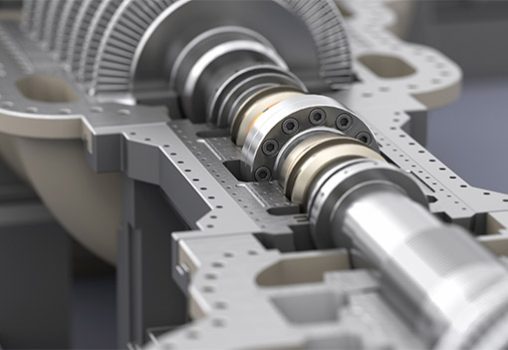
Will nickel-based alloys and titanium soon be replaced in aircraft construction? Are iron aluminides the new competing materials?
Due to their advantageous properties, non-ferrous high-performance materials such as titanium and nickel-based alloys are of great importance to the aerospace industry. At the same time, iron aluminide alloys can exhibit similar mechanical and thermal properties, combined with a significant economic advantage over other high-performance alloys. Iron aluminides thus represent a potential alternative to expensive non-ferrous alloys and, for example, in the aerospace industry, have the potential to replace established materials in components of turbomachinery such as turbine blades.
In aerospace component manufacturing, milling is an important finishing process. Iron aluminides are considered difficult to machine. Therefore, the tool wear mechanisms and phenomena that occur are the main problems when machining such alloys. These topics are not yet comprehensively addressed by the existing knowledge base. In this paper, cast iron aluminide samples were machined using ball end mills to analyze the resulting tool wear and the influence of various tool properties.
Complex starting point in the aerospace industry
The aerospace industry represents international growth characterized by the prospect of 5% annual growth. Over the next 20 years, passenger air traffic is expected to increase to almost 19 trillion passenger kilometers per year, more than double the current figure. Consequently, nearly 40,000 new aircraft deliveries are projected worldwide by 2037. In this context, fuel consumption is currently the driving force in the design of commercial aircraft due to greenhouse gas emissions and operating costs. Reduced fuel consumption can be achieved through higher engine efficiency, aerodynamic design, and lightweight construction. In addition to lightweight structural and system design, lightweight construction using high-performance non-ferrous materials such as titanium and nickel-based alloys is a promising approach due to their mechanical and thermal properties. Iron aluminide (FeAl) alloys can also exhibit similar and advantageous mechanical and thermal properties. They are characterized by a comparatively low density, excellent corrosion resistance, and high wear resistance. Furthermore, certain FeAl alloys exhibit high heat resistance. The main alloying elements, iron and aluminum, are among the most abundant in the Earth’s crust, which is why FeAl alloys offer a significant economic advantage over other high-performance materials. FeAl alloys meet the fundamental requirements for manufacturing and processing. Their suitability for existing plant engineering and the possibility of near-net-shape production enable excellent and efficient processing. Iron aluminides thus have the potential to replace established, high-priced non-ferrous alloys in components for turbomachinery such as turbine blades.
… The challenge for the best alloy: heat-resistant, lightweight, and cost-effective
Applications in gas turbines require various advantageous material properties for operating temperatures above 400 °C and for extended service life. High tensile strength and elongation, as well as a low creep rate, are essential characteristics. In recent years, several iron aluminide alloys with high strength at temperatures up to 800 °C and acceptable ductility have been developed. Due to continuous coherent precipitation, even under prolonged high-temperature stress, their strength properties do not decrease significantly. A promising example of these alloys is currently Fe₂₅Al₁₅Ta [at%], as it is already material-optimized, meaning no further metallurgical improvements are expected.
However, flow-relevant surfaces, such as those of turbine blades in turbomachinery, are subject to high accuracy requirements, making surface machining of such components currently indispensable. The favorable properties of iron aluminides, however, pose a challenge for machining processes. The greatest challenge is the high tool wear that occurs. At low cutting speeds, wear is primarily caused by mechanical tool stress and adhesion processes. At higher cutting speeds, the main wear mechanisms are tribochemical diffusion processes, leading to a rapidly progressive loss of material. The resulting cutting forces are up to three times higher than when machining steel with medium-speed tools.